
Ahead of the Quad summit on Friday, China said exchanges and cooperation between countries should contribute to mutual understanding rather than "targeting" a third party and refrain from "pursuing exclusive blocs".
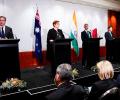
India is a driving force of the Quad and an engine for regional growth, said the White House, days after foreign ministers of the countries, which are part of the grouping, met in Melbourne.
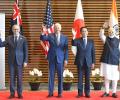
Chinese and Russian warplanes on Tuesday conducted joint air patrols over the Sea of Japan, the East China Sea and the West Pacific Ocean as the leaders of Quad held their in-person summit in Tokyo, in an apparent attempt to send a message of unity between Beijing and Moscow.
Biden welcomed Prime Minister Modi at the Summit and said "it is wonderful to see you again in person".

Price said India's relationship with Russia developed over several decades.

In the opinion piece after the summit, the leaders said the cooperation, known as "the Quad," was born in crisis. It became a diplomatic dialogue in 2007 and was reborn in 2017.

China criticised the forthcoming meeting of the Foreign Ministers of India, Australia, Japan and the United States in Tokyo, saying it is opposed to the formation of "exclusive clique" harming third party's interests.

The Quad has come of age and its agenda covering areas like vaccines, climate change and emerging technologies makes it a force for global good, Prime Minister Narendra Modi said at the first summit of the coalition. In his opening remarks, he also talked about shared values and promoting a secure, stable and prosperous Indo-Pacific.
China said on Monday that no 'exclusive cliques' should be formed as it accused some countries of trying to 'drive a wedge' among regional nations citing the 'China threat' and asserted that they will 'end up nowhere'.

"President Biden has had warm and productive early conversations with his counterparts in Australia, India, and Japan, and looks forward to engaging even more directly with our partners in the Indo-Pacific as soon as possible," a senior administration official told PTI.

India and the US are the world's largest democracies and the two countries are committed to taking on the toughest challenges together, President Joe Biden said after his first-ever in-person meeting with Prime Minister Narendra Modi at the White House.

'The MEA, hopefully, made it clear that the Indian PM can't be seen in Xi Jinping's company when China has, for all intents and purposes, annexed over 1,000 sq kms of Indian territory in eastern Ladakh, and essentially that the Wuhan spirit and the Mamallapuram spirit have turned into vinegar.'

President Biden underscored that the United States will 'continue to stand up for its interests and values and, together with our allies and partners, ensure the rules of the road for the 21st century advance an international system that is free, open, and fair', the White House said in a readout of the meeting.

The Indian and Chinese troops have been locked in a tense border standoff in eastern Ladakh since May 5, 2020, when a violent clash between the two sides erupted in the Pangong lake area.

Prime Minister Modi, who is in Japan on a two-day visit to attend a summit of the Quad leaders at the invitation of his Japanese counterpart Fumio Kishida, penned an op-ed on the vibrant relations between India and Japan in the Yomiuri Shimbun.

Modi will address world leaders from the iconic United Nations General Assembly hall on the morning of September 25, a day after he participates in the Quad Leaders' Summit in Washington, DC hosted by Biden on September 24.
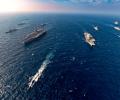
Remarks from Indian External Affairs are significant as it comes after China slammed Quad and said the formation of "exclusive cliques" targeting other countries runs counter to the trend of the times and is "doomed to fail".

US Vice President Kamala Harris would host a separate meeting with the prime ministers of three Quad countries -- India, Australia and Japan -- at the White House to discuss with them the important factors for democracies to go forward, officials said.

'There are three pillars of concern: The expansion of Hindu majoritarianism, the concentration of executive power and decay of independent institutions, and curbs on free expression and dissent.'

The navies of India, the US, Japan and Australia on Tuesday held a series of complex manoeuvres in the Bay of Bengal, kick-starting the four-day-long first phase of the Malabar naval exercise, seen as a prelude to future military cooperation among the member nations of the Quad or Quadrilateral Coalition.

Modi assured Trump that India will try to 'live up to the expectations' of the US and the world and also thanked the US President for speaking 'highly' about India during his trips.

The prime minister will have a tight schedule in the Philippines as besides attending the 15th ASEAN-India summit and 12th East Asia summit on November 14, he will have a series of other engagements including bilateral meetings with several leaders.

'Our record and our actions and stances is fairly clear and by criticising it repeatedly, it doesn't make us less credible'
The foreign ministers of the Quad grouping of India, the US, Australia and Japan on Friday held extensive talks in Melbourne amid escalating tension between Russia and NATO countries over Ukraine, the Afghan crisis and increasing concerns over China's "coercion" in the Indo-Pacific region.

At the same time, Jaishankar said India and the US are on the same page on many issues relating to the recent developments in Afghanistan including apprehensions about the possible use of Afghan soil for terrorism.

Admiral Philips Davidson, Commander of the US Indo-Pacific Command, also told the powerful Senate Armed Services Committee on Tuesday that China's recent activities along the Line of Actual Control have opened India's eyes to what cooperative effort with others might mean for their own defensive needs as he observed that New Delhi, in the very near term, will deepen its engagement with the Quad.

Interestingly, in his entire remarks, Modi never once mentioned regional security, Ambassador M K Bhadrakumar points out.
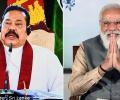
Mahinda Rajapaksa is a democratically elected leader who received a massive mandate of 71% of votes, and he owes nothing to Delhi or Washington for staging his political comeback, observes Ambassador M K Bhadrakumar.

The elephant in the room will permeate the conversations, predicts Rup Narayan Das.
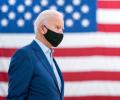
Describing India as one of the most important partners of the United States in the Indo-Pacific region, the Biden Administration on Tuesday said that it welcomes India's emergence as a leading global power and its role as a net security provider in the region.
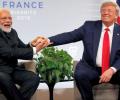
'The US President is joining the Prime Minister in addressing a huge Indian diaspora event in Houston and they will also meet on the margins of the UNGA in New York'
In his opening remarks at a ministerial meeting in Tokyo of the Quadrilateral coalition, also known as 'Quad', External Affairs Minister S Jaishankar said India remained committed to a rules-based world order, respect for territorial integrity and sovereignty, and peaceful resolution of disputes.

The prime minister's meetings with Abe and Turnbull came a day after he held "very expansive" talks with US President Donald Trump on intensifying overall security and defence cooperation, particularly in the Indo-Pacific region where China is strengthening its military build up.

The PM was also seen chit-chatting with Japanese Prime Minister Shinzo Abe, Russian Prime Minister Dmitry Medvedev and Malaysian Prime Minister Najib Razak at the reception for the leaders who have arrived in Manila for the 31st ASEAN summit and related meetings.

A weaker Russia, a sobered China at a time when Xi Jinping is manoeuvring to protect his third term prospects, a reunited West, a chaotic Pakistan. This is a perfect set of strategic circumstances. It is for India now to consummate this historic opportunity, argues Shekhar Gupta.

Biden has reiterated America's support for India's permanent membership on a reformed UNSC and its entry into the NSG during his first in-person bilateral meeting with Modi at the White House.
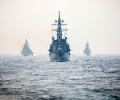
'Any future course of action towards active participation in the alliance when formed would need a lot of deliberation, long term vision and should be in our best national interests,' notes Commodore Vengalil Venugopal (retd).
India has the ability in all respects to be a great power and address our security challenges in the best national interests, says Commodore Venugopal Menon (retd).

Modi said India will continue its support to ASEAN for a rules-based security architecture for the region.
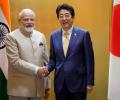
With the signing of the pact, the Quad grouping of India, Japan, Australia and the US is set to gain more heft now, notes Dr Rajaram Panda.
